Wordly Alternatives for Churches and Conferences: An Evidence-Based Buyer Guide
Compare Wordly alternatives for multilingual churches and conferences. Evaluate live audio, captions, attendee access, setup, support and pricing.
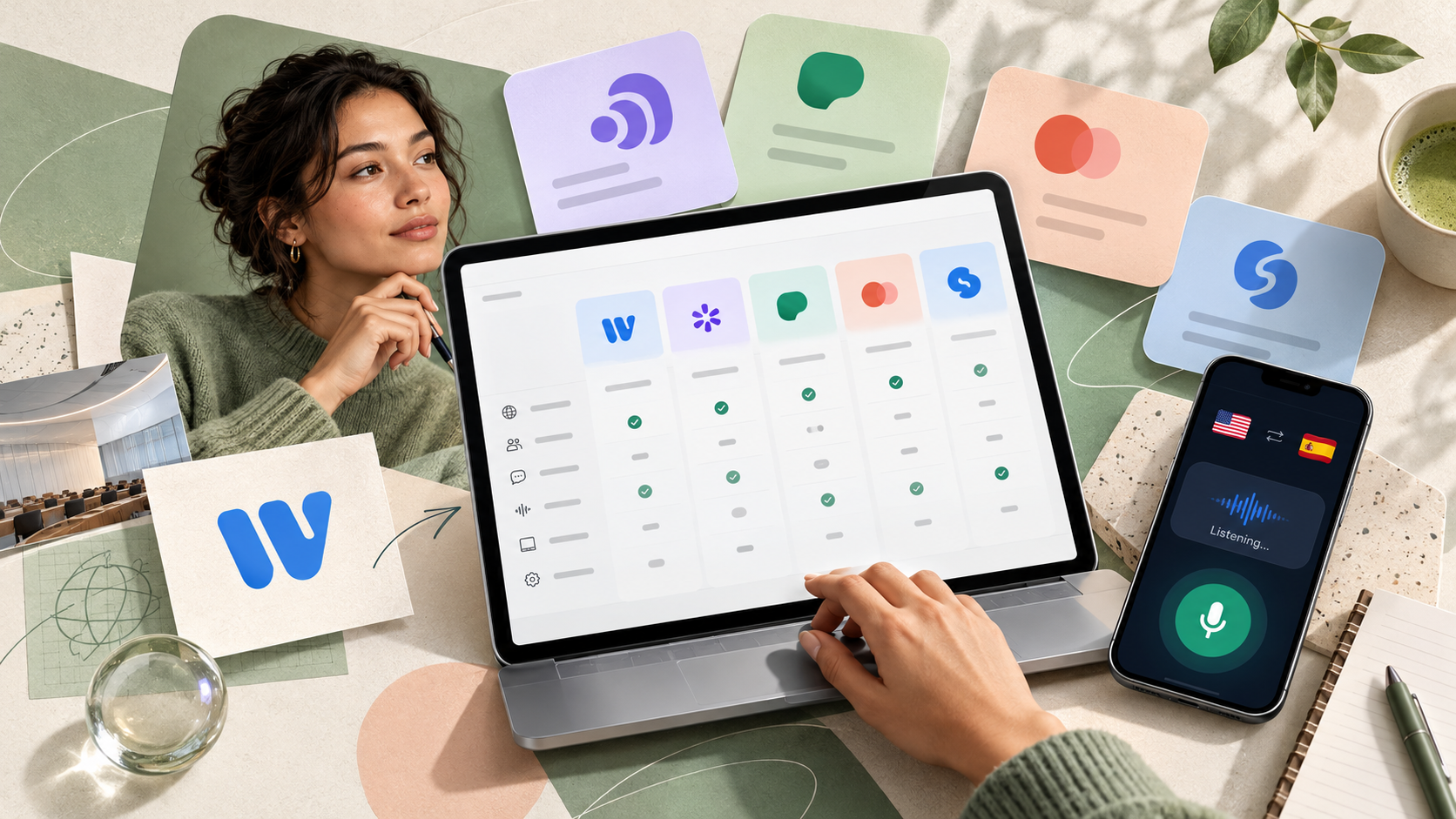
Renewal season has a way of making people quietly shop around. Boostlingo's own event-tool comparison lists nine distinct platforms, and Wordly is only one of them. Each fits a different church sanctuary, conference breakout room, or AV budget. So which Wordly alternative actually suits your congregation or corporate conference? And how can you verify capabilities before you sign a contract?
What Are the Best Wordly Alternatives for Churches and Conferences?
There is no single universal winner. Churches with dedicated AV setups should shortlist tools such as Glossa or Exbabel (this guide's publisher). Conferences that require human interpreters for diplomatic or nuanced keynotes should evaluate Interprefy or Boostlingo. LiveVoice suits organizations wanting mobile app audio distribution. Sticking points typically center around soundboard AV integration, listener smartphone access rules, human interpreter support, hybrid streaming, and total cost. Sticking with Wordly may also remain completely sensible.

Key Takeaways
- •Wordly is a legitimate incumbent. If its hour-package model and web delivery match your volunteer workflow, staying may be your lowest-friction option.
- •Organizations switch over five concrete factors: soundboard AV integration, listener app friction, human interpreter requirements, hybrid livestream sync, and pricing structures.
- •Every matrix data point in this guide traces to primary vendor pages read on October 18, 2026, or is explicitly flagged as “not stated” where documentation was silent.
- •Pricing models vary fundamentally by unit (per hour vs. per hour per language vs. unlimited monthly tiers), so convert all quotes into an annualized cost-per-event.
- •Conduct a live pilot with your own microphone audio and bilingual reviewers before committing to any annual service contract.
Let's begin with a rapid scenario breakdown, because the ideal alternative depends entirely on your operational job-to-be-done.
Quick Answer: Which Wordly Alternative Fits Your Use Case?
Select your translation architecture by workflow constraints rather than brand marketing. Each option below solves a distinct operational problem.

Churches and Recurring Worship
Weekly church services reward simple visitor onboarding and steady soundboard connections. Glossa documents real-time subtitle delivery into ProPresenter, OBS, and vMix alongside RTMP outputs. Exbabel provides QR code smartphone access, direct mixer inputs, and sub-second audio streaming as detailed in our church translation system architectural guide. LiveVoice enables volunteer or AI audio channels through a mobile app. Wordly also offers church plans (5, 10, or 25 hours per month). Shortlist two options and test both during a live Sunday service.
Conferences and Multilingual Conventions
Commercial conferences prioritize attendee concurrency, enterprise integrations, and dedicated technical support. Wordly cites integrations with Cvent, Zoom, Microsoft Teams, and Encore, and offers on-site technician support. Interprefy and Boostlingo provide certified human conference interpreters for keynote sessions where linguistic nuance is critical. Boostlingo states its Events service connects with Zoom, KUDO, and Interprefy. Request verified references from events of comparable scale, then pilot in the real auditorium before finalizing contracts.
Meetings and Classrooms
Academic lectures and internal corporate meetings rarely require translation booths or large AV crews. Wordly lists education discounts and videoconferencing integrations. LiveVoice supports Zoom, Teams, and Webex. Glossa offers four free trial hours and published pay-as-you-go rates. Educational environments require custom terminology glossaries for technical course vocabularies. For foundational definitions of consecutive vs. simultaneous delivery, see our simultaneous interpretation guide.
High-Stakes Human or Hybrid Interpretation
When a single mistranslation introduces legal exposure or diplomatic friction, engage professional human interpreters. Interprefy enables planners to select human linguists or AI engines on a per-session basis. Boostlingo provides remote simultaneous interpretation (RSI) backed by a global interpreter network. LiveVoice also supports human interpreter audio streaming. While competitor analyses frequently categorize Wordly as AI-only, confirm current capabilities directly with Wordly in writing.
What Wordly Offers and When to Look Elsewhere
As an established market incumbent, Wordly deserves a fair summary based on its published capabilities as of October 18, 2026.
Documented Event and Church Use Cases
Wordly's website describes real-time translation for in-person, virtual, and hybrid events, corporate enterprises, houses of worship, and educational institutions. Its church page highlights sermon translation, mid-week Bible studies, youth ministries, and multi-campus broadcasts. Wordly advertises custom glossaries, volunteer onboarding, technical rehearsals, and optional on-site staffing. Always request an authentic trial run with your own pastoral speakers to evaluate real acoustic performance.
Attendee Access and Supported Outputs
Wordly allows attendees to scan a QR code or access a web URL from personal devices without mandatory app downloads. The platform outputs translated audio into earbuds, live captions on mobile screens, and synchronized subtitles onto auditorium projection screens. Wordly's site cites 60+ languages in some sections and dozens in others. Confirm your congregation's required language pairs in writing prior to commitment.
Questions to Ask About Support, Pricing and Integration
Ask what level of live technical support is included in your base package and who answers support calls during a Sunday morning or evening keynote. Inquire about specific hardware AV connections: while Wordly's home page mentions mixer inputs, its dedicated church page does not explicitly document ProPresenter or audio matrix routing. Clarify how unused hours roll over from month to month, as pricing pages direct buyers to sales representatives for rollover terms.
How We Selected Alternatives and Verified Evidence
Any vendor can publish a competitor list. A rigorous buyer guide must disclose its evaluation methodology, review dates, and evidence boundaries.

Inclusion Criteria: Relevant Live Multilingual Delivery
We evaluated platforms that deliver live multilingual audio, real-time captions, or simultaneous interpretation directly to audience members and that publish dedicated product documentation. This yielded five primary alternatives: Exbabel, Interprefy, Boostlingo, LiveVoice, and Glossa. Generic document translation tools, offline transcription bots, and non-real-time utilities were excluded.
Primary Documentation and Review Dates
All vendor claims originate from official websites, knowledge bases, and published pricing pages accessed on October 18, 2026. Third-party competitor blog posts are treated strictly as secondary opinion and never as verified proof of another vendor's technical limitations. Because SaaS features and rates change regularly, buyers should re-verify all published specifications at the time of purchase.
First-Hand Testing and Evidence Gaps
Where a vendor's official documentation was silent regarding a capability, we designated the item as “not stated” (NS) rather than presuming the feature is absent. A lack of public documentation simply highlights a topic requiring direct clarification during vendor demonstrations.
Disclosure of Exbabel Authorship
Exbabel publishes this guide and develops one of the featured real-time translation platforms. This represents an inherent commercial interest. To ensure objective utility, this analysis cites verifiable primary sources, marks unverified claims transparently, and applies identical evaluation criteria across all platforms.
| Evaluation Criterion | What to Audit | Required Verifiable Evidence |
|---|---|---|
| Source audio | Mixer feed, RTMP stream, USB interface, or phone mic | Official setup guide or physical line-level audio test |
| Language coverage | Exact required source and target language pairs | Contractual language schedule and acoustic test |
| Translated audio & captions | Availability of spoken voice, live text, and concurrent delivery | Published feature documentation plus live dual-stream test |
| Attendee experience | Onboarding steps, app download requirements, reconnection | Trial runs on iOS Safari and Android Chrome |
| Event capacity | Concurrent listener caps, bandwidth scaling, and channel ceilings | Written concurrency limits stated in SLA proposals |
| AV setup time | Hardware footprint, volunteer skill requirements, operator demands | Timed setup log recorded by in-house AV volunteers |
| Technical support | Operational hours, Sunday availability, escalation bridge | Written SLA detailing real-time response windows |
| Data privacy | Audio storage, transcript retention, model training policies | Legally binding privacy schedule and compliance reports |
| Total cost of ownership | Hour packages, per-language surcharges, overages, add-ons | Itemized, dated vendor proposal covering all annual hours |
Wordly Alternatives for Live Church and Event Scenarios
Each profile reviews what the platform is, documented use cases, workflow differentiators, verification status, and optimal deployment fits.
Exbabel: Church and Event Real-Time Translation
Exbabel (the publisher of this guide) develops real-time speech translation infrastructure engineered for houses of worship and live events. Its how-it-works architecture documents direct mixer inputs and streaming feeds, streaming AI translated audio and synchronized captions via browser QR codes without app downloads or attendee logins. Its church implementation guide details integrations with OBS, vMix, Wirecast, and RTMP encoders. Shortlist Exbabel if your ministry requires soundboard-level audio capture and seamless phone listening.
Interprefy: Managed Event Interpretation
Interprefy is an enterprise-grade managed language platform supporting both certified human conference interpreters and automated AI translation. Interprefy documentation highlights the ability to select human linguists or AI processing on a per-session basis (e.g. allocating human interpreters to plenary keynotes and AI to parallel technical workshops). Attendees connect via web or native apps. Shortlist Interprefy for large, international hybrid conventions with high diplomatic stakes.
Boostlingo: Interpretation and Event Delivery
Boostlingo combines on-demand interpreter networks with AI captioning and conference delivery. Its events platform documents remote simultaneous interpretation (RSI) compatible with Zoom, KUDO, and Interprefy, alongside traditional on-site infrared (IR) and FM radio frequency transmission hardware. Shortlist Boostlingo when enterprise human interpreter scheduling is your primary operational requirement.
LiveVoice: Event and Congregation Audio Distribution
LiveVoice delivers live audio and simultaneous interpretation primarily through dedicated smartphone apps. Its churches page highlights human interpreter streaming, remote speaker channels, and AI-generated live captions. Sessions are distributed via web links, invite codes, or QR codes. LiveVoice mentions free trial access and tailored packages for non-profit houses of worship. Shortlist LiveVoice if your volunteers are comfortable managing a mobile app listening environment.
Glossa: Church-Focused Translation Approach
Glossa is an AI translation platform built specifically for church worship services. Its website describes browser-based attendee listening without app downloads, alongside caption overlays for ProPresenter, OBS, and vMix. Published pricing starts at $5 per hour per language with monthly plans beginning at $99. Glossa does not document human interpreter integration. Shortlist Glossa for small-to-midsize churches seeking straightforward livestream subtitle overlays.
Side-by-Side Comparison Matrix
A comparison matrix is only valuable when every cell is verifiable. The matrix below utilizes standard editorial verification codes rather than vague marketing checkmarks:
Captions vs Translated Spoken Audio
Captions assist visual readers and noisy foyers, whereas synthesized spoken audio serves worshippers who cannot look at a screen. Wordly, Exbabel, Glossa, and LiveVoice document both voice and caption outputs. Boostlingo and Interprefy document human spoken interpretation alongside AI captioning options. Verify that your chosen platform delivers both modalities reliably on consumer mobile devices.
Listener Access: QR, Browser, App, Receivers
Wordly, Exbabel, and Glossa provide frictionless browser listening via QR codes without native app installation. LiveVoice delivers audio through a mobile application with invite code sharing. Interprefy supports both web browsers and mobile apps. For older congregants without smartphones, evaluate loaner devices or physical RF hardware as outlined in our church translation apps guide.
AV Integrations, Streaming, Administration and Support
Glossa and Exbabel document direct integration with church presentation suites (ProPresenter) and broadcast encoders (OBS, vMix, Wirecast, RTMP). Wordly highlights event platform partnerships (Cvent, Zoom, Teams, Encore) and mixer connectivity. Support packages range from self-service email to on-site technicians. Request a live audio demonstration utilizing your church's exact mixing console before committing.
Language Support, Data Handling and Compliance Claims
Language counts vary across pages: Wordly cites 60+ in some sections and dozens in others, while Glossa advertises 100+. Exbabel avoids publishing unverified aggregate counts. Vendor compliance assertions (e.g. SOC 2 or GDPR) remain claims until verified via audit documentation. Request formal data retention schedules and written confirmation that congregation audio is never utilized for machine learning model training.
| Platform | Spoken Audio | Live Captions | Listener Access | AV & Streaming Support | Human Interpreters | Published Base Pricing | Source Citations |
|---|---|---|---|---|---|---|---|
| Wordly | Confirmed (C) | Confirmed (C) | C: QR or URL link, zero app downloads | C: Mixer, Zoom, Teams, Cvent, Encore; NV: ProPresenter | NV on Wordly pages | C: Starts at ~$1,500 for 10-hr bundle | wordly.ai, /church-translation, /pricing |
| Exbabel | Confirmed (C) | C: Synchronized | C: QR or URL link, zero app or account | C: Mixer/stream input; OBS, vMix, Wirecast, RTMP | Not Verified (NV) | Custom SaaS plans | exbabel.com/how-it-works, church guide |
| Interprefy | C: Human & AI | Confirmed (C) | C: Web platform & mobile app | NV: Mixer; enterprise integrations claimed | C: Per-session human or AI | Quote required | interprefy.com knowledge base |
| Boostlingo | C: Human RSI; NV: AI audio | C: AI Captions | Not Verified (NV) | C: Zoom, KUDO, Interprefy; IR & FM hardware | Confirmed (C) | Quote required | boostlingo.com events page |
| LiveVoice | Confirmed (C) | C: AI Live Captions | C: App; link, invite code, QR; NV: Browser | C: Zoom, Teams, Webex integrations | C: Human or AI | Free trial; custom church quote | livevoice.io/en/churches |
| Glossa | Confirmed (C) | Confirmed (C) | C: Browser URL link, no app download | C: ProPresenter, OBS, vMix, RTMP stream | NV: Not mentioned | C: $5/hr/lang; plans from $99/mo | glossa.live |
Buyer Scenarios and Real Decision Trade-Offs
Two platforms can both be technically competent; optimal selection hinges on your specific operational constraints.

Sunday Sermon and Multi-Language Congregation
Examine your audio routing first. If your production team uses ProPresenter and OBS, Glossa and Exbabel offer direct software integrations. If volunteers prefer managing volunteer channels through smartphone software, LiveVoice fits well. If your church already uses Wordly successfully, retaining your existing contract may avoid volunteer re-training overhead. Keep loaner earbuds at welcome kiosks, and remember that software tools do not replace certified American Sign Language (ASL) interpreters.
One-Day Convention with Remote Attendees
Single-day events require rapid deployment with zero room for error. Wordly's church documentation states hybrid usage carries no additional charge, pricing strictly by hour bundles. Interprefy and Boostlingo excel when hybrid plenary sessions require accredited human interpreters. Ensure remote streaming feeds preserve discrete language channels, and maintain a printed operational checklist at the sound booth.
University Lecture or Public Meeting
Academic and civic assemblies require rapid attendee onboarding and archived transcripts. Wordly provides educational discounts, while Glossa and LiveVoice offer entry tiers. Municipal public meetings often carry legal accessibility mandates; consult legal counsel to ensure compliance.
Multitrack Hybrid Conference
Concurrent breakout halls multiply potential technical failure points. Interprefy's hybrid model allows planners to assign human interpreters to main hall keynotes while deploying automated AI translation across overflow sessions. Map language channel allocations per room, assign a dedicated AV lead to each stage, and review our best real-time translation apps comparison for additional feature breakdowns.
Price and Total Cost of Ownership
Headline software rates rarely reflect full annual expenditure. True total cost of ownership (TCO) incorporates billing units, language count multipliers, and volunteer operational labor.
Event Duration and Number of Sessions
Wordly bills hours strictly as consumed without rounding up (e.g. a 30-minute sermon consumes 30 minutes of plan time). Glossa bills translation hours on a per-hour, per-language basis (e.g. a 1-hour service translated into 3 languages consumes 3 translation hours). Account for setup time, technical rehearsals, and soundchecks when estimating annual usage.
Language and Listener Volume Assumptions
Some vendors charge fixed rates regardless of language count, while others multiply costs per added tongue. Glossa states audience size does not impact pricing. Wordly provides single pricing across all supported languages. Clarify attendee overage charges and unused hour rollover policies in writing before signing annual agreements.
Software Fees, Interpreters, Equipment and Technical Support
Software subscriptions represent only a portion of the total budget. Factor in USB audio interfaces, stage microphones, loaner earbuds, and sound technician labor. For an exhaustive hardware bill of materials, consult our church translation equipment guide.
| Platform | Published Pricing Signal | Billing Unit | Critical Buying Caveat |
|---|---|---|---|
| Wordly | Starts at ~$1,500 for a 10-hour package; 12-month validity | Tiered hour blocks | Unused hour rollover terms negotiated via sales; 10% non-profit discount on higher tiers |
| Glossa | Pay-as-you-go $5/hr/lang; Standard $99/mo (25 hrs); Advanced $299 (100 hrs); Premium $499 (250 hrs) | Hours per language | Multiplies with every active target language; includes 4-hour free trial |
| LiveVoice | No public pricing on church page; free trial mentioned | Not stated | Must request formal quote tailored to non-profit scale |
| Interprefy / Boostlingo / Exbabel | Custom event & annual enterprise subscriptions | Not stated publicly | Request formal written proposal specifying concurrency and support inclusions |
| Budget Line Item | Option A (Incumbent / Wordly) | Option B (Alternative 1) | Option C (Alternative 2) | Verification Source |
|---|---|---|---|---|
| Sessions per year | Annual service count | Annual service count | Annual service count | Ministry calendar |
| Hours per session (incl. rehearsal) | Runtime + 30 min buffer | Runtime + 30 min buffer | Runtime + 30 min buffer | Run of show |
| Active target languages | Language count | Language count | Language count | Congregational survey |
| Peak concurrent listeners | Peak mobile devices | Peak mobile devices | Peak mobile devices | Sanctuary seating capacity |
| Software subscription fee | Tiered package cost | Tiered package cost | Tiered package cost | Vendor pricing quote |
| Human interpreters (if required) | N/A or external agency | Platform linguists | Platform linguists | Agency fee schedule |
| AV hardware & loaner devices | USB interface & earbuds | USB interface & earbuds | USB interface & earbuds | AV equipment invoice |
| Technical operator labor | Staff or volunteer time | Staff or volunteer time | Staff or volunteer time | Production payroll |
| Estimated Annual Total Cost | Option A Total | Option B Total | Option C Total | Annual budget line |
How to Test an Alternative Before Switching
Never transition systems based on a sales presentation alone. A rigorous pilot utilizes your sanctuary microphones, real speaker cadence, and typical congregation devices.

Define Acceptance Criteria and Select a Sample Segment
Establish quantitative benchmarks prior to testing: maximum latency threshold, pronunciation accuracy for biblical names and theological terms, onboarding completion time, and live support response time. Select a representative five-minute sermon recording featuring rapid speech, scripture recitation, and typical room acoustics.
Run the Same Audio in Target Languages
Feed the identical audio recording into each candidate platform using identical input gain and audio interfaces. Record the generated speech and caption feeds. Repeat the evaluation with a live presenter speaking from the pulpit. Blind the platform names during evaluation if possible to eliminate reviewer bias.
Test iPhone/Android, Wi-Fi/Mobile Data and Reconnect
Connect to streams from current and older iPhones and Android smartphones over venue Wi-Fi and cellular 5G. Walk to the back corners of the sanctuary. Toggle airplane mode to simulate signal loss, then lock and unlock phone screens to verify automatic audio reconnection. Time how long a first-time guest takes to connect without volunteer assistance.
Review Translation Errors with Qualified Speakers
Engage bilingual congregants to categorize translation errors: syntax errors, omissions, mistranslated theological concepts, or garbled names. Score source and target languages independently. Maintain human interpreters for intimate pastoral prayers, communion services, or sensitive pastoral counseling.
| Pilot Audit Item | Mandatory? | Target Pass Benchmark | Evaluation Result |
|---|---|---|---|
| Source audio capture | Yes | Clean speech ingestion from mixer AUX/Matrix split without distortion | [ Pass / Fail ] |
| Bilingual accuracy review | Yes | Theological terms and biblical names translated fluently by native reviewers | [ Pass / Fail ] |
| Device compatibility | Yes | Zero-download audio and caption sync across iOS Safari and Android Chrome | [ Pass / Fail ] |
| Network reconnection | Yes | Audio stream automatically resumes within 3 seconds of Wi-Fi toggle | [ Pass / Fail ] |
| Visitor onboarding speed | Yes | First-time visitor scans QR code and begins listening unaided in < 90 seconds | [ Pass / Fail ] |
| Operational failover plan | Yes | Named AV operator and written cellular hotspot fallback verified | [ Pass / Fail ] |
| Data retention & training policy | Yes | Written confirmation that church voice data is not used for AI model training | [ Pass / Fail ] |
| Live Sunday technical support | Yes | Dedicated support contact reachable during live weekend worship services | [ Pass / Fail ] |
| Itemized pricing proposal | Yes | Binding quote stating hour allocations, overage rates, and renewal caps | [ Pass / Fail ] |
| Final Vendor Decision | — | All mandatory criteria satisfied | [ Go / No-Go ] |
Frequently Asked Questions
What Are the Best Alternatives to Wordly for Churches?
The best alternative depends on your AV signal chain and congregation demographics. Glossa, Exbabel, and LiveVoice document specific house of worship workflows. Glossa and Exbabel focus on direct soundboard audio capture, ProPresenter/OBS video captioning, and browser-based smartphone listening. LiveVoice suits ministries wanting mobile app listening with human interpreter volunteer channels. Staying with Wordly remains sensible if your team is already trained on its interface and your budget accommodates hour packages.
What Wordly Competitors Offer Live Event Translation?
Interprefy, Boostlingo, LiveVoice, Glossa, and Exbabel all describe real-time translation for live conferences and gatherings. In addition, Boostlingo's industry review lists nine enterprise platforms including Zoom, Microsoft Teams, KUDO, Interactio, DeepL Voice, and Palabra.ai. Always consult each provider's current documentation for supported venue inputs and concurrent channel capabilities.
How Does Wordly Compare With Exbabel?
Both systems deliver real-time speech translation and synchronized captions via QR code or browser links without mandatory attendee app downloads. Wordly publishes annual hour-based pricing packages starting at approximately $1,500 for 10 hours. Exbabel provides sub-second streaming architecture, line-level mixer integration, and broadcast tool routing (OBS, vMix, RTMP) designed specifically for recurring church and live event environments.
Are Wordly Alternatives Less Expensive?
Not automatically; billing structures differ significantly across platforms. Wordly charges by tiered hour packages (e.g. 10-hour bundles), Glossa bills per hour per language with monthly base plans, while platforms like Interprefy, Boostlingo, and Exbabel provide custom event or unlimited annual tiers. You must model your specific annual service hours, target languages, and rehearsal time to determine true bottom-line costs.
Does an Alternative Require Listeners to Download an App?
Not necessarily. Glossa, Exbabel, and Wordly allow attendees to join instantly by scanning a QR code with their camera and opening a web browser. LiveVoice operates primarily through a dedicated listener app, while Interprefy offers both mobile apps and web platforms. Always test guest onboarding on older iOS and Android devices over venue Wi-Fi before deciding.
How Should a Conference Compare Translated Audio and Multilingual Captions?
Match delivery to audience cognitive needs. Spoken translated audio suits attendees who cannot look continuously at screens (e.g. drivers, visually impaired visitors, or plenary attendees focusing on visual demonstrations). Translated captions suit noisy trade show floors, non-native visual readers, and hard-of-hearing guests. Whenever possible, choose a platform capable of streaming both simultaneously.
Can a Hybrid Interpretation Workflow Serve Complex Events?
Yes. Platforms such as Interprefy allow organizers to deploy accredited human conference interpreters for high-stakes executive keynotes while routing secondary breakout tracks to cost-effective AI translation engines. LiveVoice similarly accommodates both human volunteer channels and AI captioning feeds.
What Should Buyers Ask About Data Privacy and Support?
Ask where live speech audio and transcripts are processed, what the retention period is, and obtain a legally binding guarantee that your organization's voice data is not used to train third-party foundation models. Additionally, verify live technical support hours: ensure an AV specialist is reachable on Sunday morning or during your conference kickoff.
Source Log and Documented References
To maintain complete editorial integrity and research transparency, all vendor websites, technical knowledge bases, and published pricing documentation cited in this comparison are logged below:
| Organization / Source | Publication URL / Reference | Application in Article | Citation Type |
|---|---|---|---|
| Wordly Home | wordly.ai | Core use cases, QR/link access, output channels, event platform partnerships, compliance claims | Official vendor claim |
| Wordly Church Translation | wordly.ai/church-translation | House of worship packages (5/10/25 hours/mo), hybrid inclusion, hardware-free delivery | Official vendor claim |
| Wordly Pricing | wordly.ai/pricing | ~$1,500 base tier for 10-hour package, 12-month validity window, 10% nonprofit terms | Official vendor pricing |
| LiveVoice for Churches | livevoice.io/en/churches | App-based listener delivery, invite code and QR access, human or AI channels, free trial mention | Official vendor claim |
| Glossa Live | glossa.live | Browser link, ProPresenter, OBS, vMix, RTMP outputs, $5/hr/lang rates, 4-hour trial | Official vendor claim |
| Interprefy Knowledge Base | interprefy.com blog | Per-session human or AI selection; industry perspective categorizing Wordly as AI-only | Vendor buyer guide / opinion |
| Boostlingo Events & Blog | boostlingo.com blog | Nine-platform comparison matrix, RSI and RF/IR transmission, evaluation framework | Competitor comparative analysis |
| Exbabel Product Documentation | How Exbabel Works | Speech-to-speech AI streaming, browser QR access, audio + synchronized captions | Exbabel product architecture |
Editorial Disclosure: Published by Exbabel. This article provides technical and comparative software analysis for house of worship committees, conference organizers, and corporate production teams. Platform pricing tiers, software feature sets, and third-party integrations change periodically. Buyers should always confirm contractual terms, data privacy schedules, and SLA commitments directly in writing with respective vendors.
Related AI Translation & Church AV Insights
Simultaneous Interpretation: How It Works, Costs and Event Setups
Two interpreters share a booth and swap roughly every 30 minutes, according to the ATA. Here is how simultaneous interpretation actually works, what on-site and remote equipment costs, and how event planners can evaluate human, AI, and hybrid options.
Live TranslationBest Real-Time Translation Apps for Live Events (2026)
Your phone can interpret a dinner conversation. A keynote for hundreds is another job entirely. Here is an evidence-backed buyer's comparison of real-time translation apps for meetings, churches, and live events in 2026.
Church TranslationChurch Translation Apps vs Browser Links and Headsets
A visitor scans your QR code, picks a language and hears nothing. WebKit says Safari needs a tap before audio plays. Here is what church translation apps really need to do—and why an app might not need to be an app at all.
Stream Live Sermon Translation to Every Smartphone
Zero hardware rentals. Zero app downloads. Worshippers simply scan a QR code from the pew to hear clear translated voice and follow synchronized captions in their native language.