Simultaneous Interpretation: How It Works, Costs and Event Setups
An evidence-backed operational roadmap for conferences, hybrid summits, and corporate multilingual events.
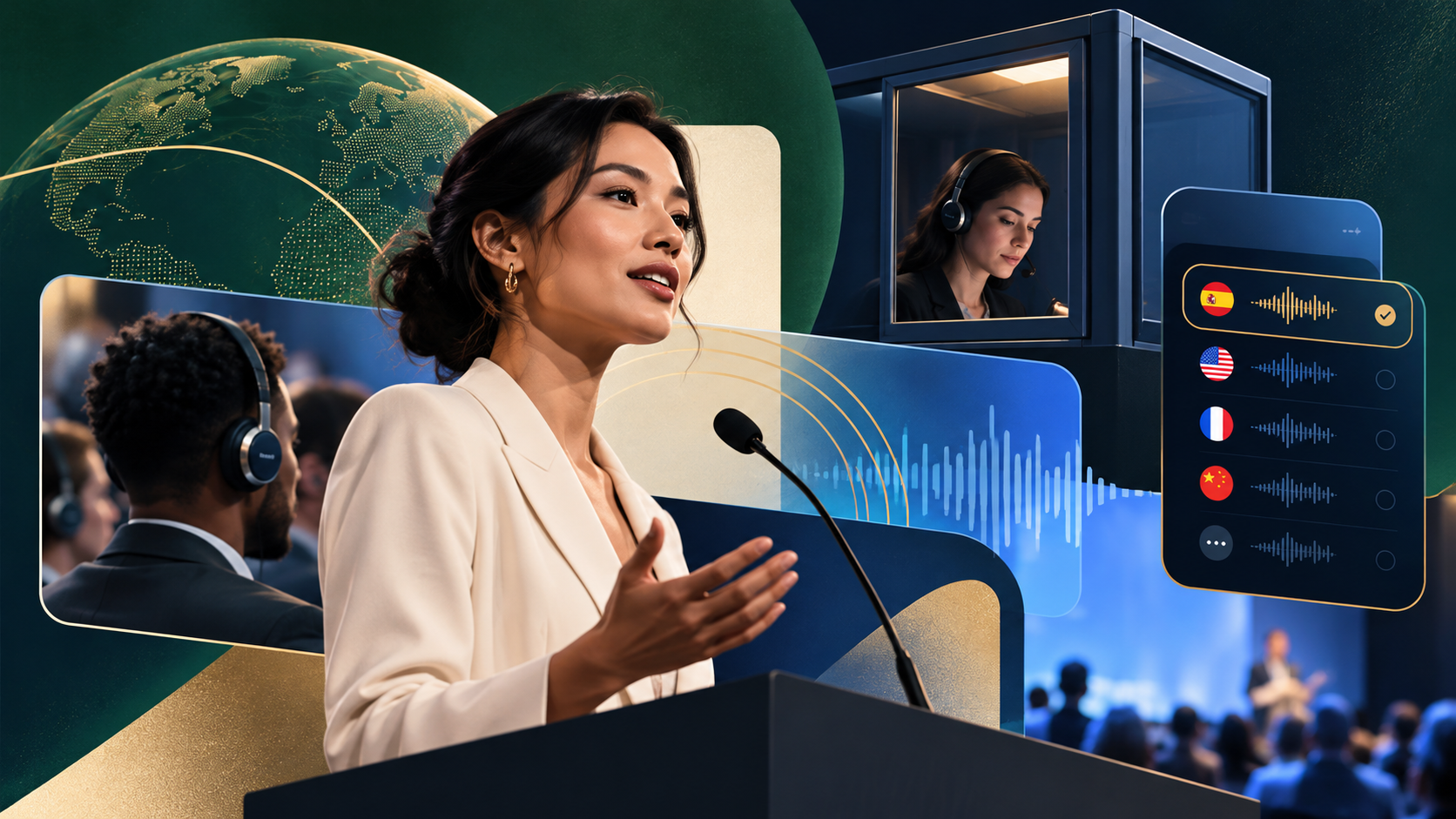
Two interpreters share a booth and swap roughly every 30 minutes, according to the American Translators Association (ATA). Why? Holding a speaker's words in your head while speaking another language is demanding work. Event planners rarely see that cognitive effort—only the attendee headsets. So how does simultaneous interpretation actually work? And what does it take to run it successfully?
What Is Simultaneous Interpretation and How Does It Work?
Simultaneous interpretation means an interpreter renders a speaker's words into another language while the speaker keeps talking. Listeners hear the result on headsets or a phone. On-site events use booths and consoles. Remote events use human interpreters joining online, which is called remote simultaneous interpretation (RSI). AI systems add a third route, though some work in short segments rather than truly at once. Problems start with poor audio, weak connections and unclear channel setups.
Key Takeaways
- •Simultaneous interpreting happens while the speaker talks, whereas consecutive interpretation waits for a natural pause.
- •RSI means human interpreters working remotely. It does not automatically imply AI translation.
- •Clean speech audio decides everything downstream for human linguists and software pipelines alike.
- •Price depends on languages, hours, equipment, and staffing. Always demand itemized written quotes.
- •Run a pilot with strict go/no-go criteria before signing any vendor contract.
Let's start with the definition, because plenty of event briefs mix up three fundamentally different language services.
What Simultaneous Interpretation Means
Get the vocabulary straight first. Mixing up interpreting modes is the fastest way to buy the wrong service for your event. Here are the three distinctions that matter most.

Working While the Speaker Continues
The American Translators Association defines simultaneous interpreting as interpreting at the same time as another speaker. Interpreters hear the speech through headphones and speak into a microphone for listeners. Because that's intense cognitive work, they usually share the job with a partner and switch about every 30 minutes. Look, a short lag always exists. ATA calls that delay the ear-voice span. It varies by language pair and syntactic complexity.

Simultaneous vs Consecutive vs Translation of Documents
Consecutive interpreting waits until the speaker finishes. ATA ties it to short speeches of up to about ten minutes in medical, legal and business settings. Whispered interpreting (chuchotage) serves one or a few listeners without electronic equipment. Translation is a different service altogether because it converts written text. So an event brief that asks for a “translator” may really need an interpreter. Clarify the terminology before you request vendor quotes.
When Delay Changes the Experience
Delay matters most when listeners can also see the speaker, the presentation slides, or a live Q&A chat. A noticeable lag between a presenter's punchline and its translated delivery feels awkward in the auditorium. Human interpreters trail the speaker by a short span of 2 to 5 seconds. Some AI pipelines add buffer processing time on top. Exbabel's how-it-works documentation describes streaming translated output within seconds directly to browser devices. Always ask every vendor for measured latency numbers under load.
| Service | What It Converts | When It Happens | Typical Fit |
|---|---|---|---|
| Simultaneous interpreting | Speech to speech | While the speaker talks | Conferences, longer keynotes, multilingual plenary sessions |
| Consecutive interpreting | Speech to speech | After the speaker pauses | Short speeches, bilateral meetings, clinical & legal appointments |
| Whispered interpreting (Chuchotage) | Speech to speech | While the speaker talks | One or a few listeners in the same room without hardware |
| Document translation | Written text | Before or after the event | Slides, printed handouts, event apps, venue signage |
The Event Audio Path
Every interpreted event follows the exact same signal chain: speech in, interpretation in the middle, and language channels out to attendees. Weak links can hide at any stage. Here is how each link operates.

Stage Microphones and Clean Mixes
Interpreters can only translate what they hear clearly. Feed them a clean, dedicated speech mix with house music and room reverberation kept out. Each presenter needs a reliable microphone (directional lavalier, handheld, or podium mic). Panel events need clear microphone handoffs. Remote presenters need broadcast-quality headsets. ISO 20108 covers the quality of sound and image input that reaches interpreters, according to AIIC technical standards. Consult our audio and mixer setup guide for wiring AUX and matrix splits from digital mixing consoles.
Interpreter or AI Processing Point
At a live venue, human interpreters sit in a booth and monitor the speaker through closed-back headphones. Remote interpreters hear an encrypted digital platform feed instead. AI interpretation systems sit at the exact same point in the audio chain. They ingest the mixer feed or live video stream, transcribe spoken phonemes, translate the text, and synthesize natural speech. Where this processing stage lives decides who monitors it and what procedures take over if a link drops.
Distribution by Channel to Attendees
Each target language gets its own broadcast channel. On site, an RF or infrared transmitter beams those channels to physical bodypack receivers. Boostlingo lists infrared and FM transmission among traditional event technologies. Remote attendees pick a language inside their videoconference platform. Modern AI platforms like Exbabel deliver audio and synchronized captions directly via a browser QR code or link, requiring no native app installation. Whatever route you select, label language channels clearly and post instructions at entryways.
| Stage | In-Person Event | Remote or Hybrid Event | Who Owns It |
|---|---|---|---|
| 1. Speech capture | Stage mics into front-of-house mixer | Speaker mic or headset into platform | Audio engineer or stream producer |
| 2. Clean feed | Dedicated speech mix to booths | Platform or mixer feed to interpreters or AI | FOH audio engineer |
| 3. Interpretation | Interpreters in booths with consoles | Interpreters online, or AI software engine | Interpreter team lead or vendor |
| 4. Channel output | Transmitter to wireless receivers | Language channels in platform or mobile browser | Technician or platform operator |
| 5. Listener access | Headsets, signage, spare receivers | QR code, web link, or platform menu | Event hospitality staff |
| 6. Monitoring | Technician watches audio levels & booths | Producer watches interpreter status & channels | Named AV technical lead |
Traditional On-Site Systems: Booths, Consoles & Hardware
On-site simultaneous interpretation still relies on purpose-built hardware and trained audio technicians. International standards govern much of this gear. Here is what the equipment does and where failures typically occur.
Interpretation Booths and Consoles
Interpreters work inside enclosed booths that block external hall noise. According to AIIC, ISO 2603:2016 covers permanent built-in booths, while ISO 4043:2016 covers mobile, transportable booths. Each interpreter operates a dedicated desktop console to select incoming feeds, control monitor volume, mute for coughing, and switch outgoing channels. Mobile booths require significant venue floor space, ventilation clearance, and direct visual line of sight to the presenter. Check current ISO editions before finalizing venue agreements.
Receivers, Headsets and Language Channels
In traditional rooms, listeners wear headsets connected to bodypack receivers tuned to their target language frequency. Boostlingo lists infrared (IR) and FM radio transmission systems among event options. IR requires line-of-sight emitters and cannot penetrate walls, offering high privacy. FM penetrates walls but may experience local radio frequency interference. Plan receiver inventory, spare batteries, and charging docks in advance. Most importantly, staff an exit recovery station: unreturned headsets are an expensive post-event surprise. Our detailed church translation equipment guide illustrates a worked equipment replacement model.
Sound Engineering and Contingency
Test stage microphones, matrix routing, and headphone gain in the real auditorium before attendee registration opens. Assign one dedicated technician to monitor the interpreter feed throughout the program. Keep spare batteries, cables, and backup receivers at the sound booth. Most importantly, plan for unexpected outages: if a booth console drops audio, who notifies the stage manager and how fast? Document the protocol and rehearse it with your AV crew.
Remote Simultaneous Interpretation (RSI)
Remote simultaneous interpretation moves the physical booth to the cloud. The interpreters are still professional human linguists working in real time; only their physical location and the transmission medium change.

Remote Interpreter Monitoring
Remote interpreters watch and hear the stage through an RSI platform rather than through booth glass. Interprefy notes that it runs strict technical soundchecks with interpreters before each event. Designate an online producer to monitor interpreter connections, audio levels, and partner handovers live. Decide beforehand how the producer contacts an interpreter if their home internet glitches. A silent language channel is easy to miss when ownership is ambiguous.
Latency and Connectivity
Interprefy requires interpreters to use wired Ethernet connections rather than Wi-Fi. Platform specifications call for a minimum of 2 Mbps symmetrical bandwidth, with 10 Mbps down and 4 Mbps up recommended, alongside ping under 50 ms and jitter under 15 ms. Treat these as baseline industry benchmarks and verify your provider's technical requirements. Test connections at the actual remote interpreter locations during a live rehearsal.
Event-Platform and Audience Delivery
RSI platforms integrate into mainstream videoconferencing software so virtual attendees can select an audio channel, according to the ATA. Boostlingo notes that event services integrate with tools such as Zoom, KUDO, and Interprefy. Verify native channel limits, whether attendees must download third-party apps, and whether multi-language session recordings are preserved for on-demand playback.
AI Interpretation and Translated Captions
Artificial intelligence offers an alternative route for multilingual conferences. It behaves differently from a human interpreter booth. Evaluate it on its own technical merits.
Transcription, Translation and Speech Generation
Most modern AI interpretation platforms execute a three-stage pipeline: automated speech recognition (ASR), neural machine translation (NMT), and neural text-to-speech (TTS) voice synthesis. Exbabel's platform ingests mixer audio and streams translated speech and captions within seconds. Because models process incoming speech in conversational buffers, verify how each vendor handles speaker pauses, rapid articulation, and overlapping voices during technical demonstrations.
Difference Between Live Captions and Audio Interpretation
Live captions project translated text on overhead auditorium screens or attendee phones. Audio interpretation synthesizes translated speech into headphones. Exbabel enables attendees to hear AI audio and read synchronized captions simultaneously. Multimodal delivery assists attendees in noisy exhibition halls, non-native visual readers, and hard-of-hearing guests. Note that captions and voice translation do not replace certified American Sign Language (ASL) interpreters for legal accessibility compliance.
Quality Controls and Sensitive Scenarios
AI systems benefit from preparation. Provide your translation platform with speaker names, product terminology, and acronyms in advance to tune vocabulary recognition. Have a bilingual coordinator spot-check output during the keynote. Reserve human interpreters for high-stakes medical, legal, or delicate diplomatic sessions where minor nuances carry significant legal implications. For hybrid broadcasts, our live broadcasting guide covers measuring audio and caption sync across live streams.
Pricing and Cost Factors: Building Your Budget
No honest universal price quote exists for simultaneous interpretation. Total expenditure depends on human staffing, hardware logistics, and software volume. Use the itemized framework below to evaluate bids.
Interpreter Staffing and Language Coverage
Human interpreting costs scale directly with team size. ATA standards emphasize that simultaneous interpretation requires two interpreters per language pair swapping every 30 minutes. Adding three languages requires six professional linguists. Rare language pairs may involve higher daily minimums and travel stipends. Always request written proposals detailing hourly thresholds, preparation time, and cancellation contingencies.
Equipment, Infrastructure and Technician Time
On-site hardware adds distinct line items: booths, consoles, transmitters, receivers, antennas, sanitation, and audio engineers. Rented gear often mandates dedicated AV labor for setup and striking. Remote RSI setups replace hardware freight with software licensing and remote technical producers. Compare total landed costs across your entire multi-day schedule.
Usage-Based Software and Event Volume
Software-driven translation platforms typically price by streaming hours, concurrent languages, or registered attendee counts. Convert every vendor quote into an effective cost-per-event metric, including rehearsal and setup hours. Inquire whether unused streaming hours roll over and verify overage rates. For an in-depth breakdown of subscription tiers vs. minute bundles, see our on-demand interpretation services analysis.
| Cost Element | Pricing Type | Quote A (On-Site Hardware) | Quote B (Remote RSI) | Quote C (AI Speech Translation) | Source & Date |
|---|---|---|---|---|---|
| Setup or onboarding | Fixed fee | Delivery, booth build & strike | Platform room configuration | Session & QR link generation | Proposal date |
| Interpreter teams | Per language pair | 2 interpreters per language | 2 remote interpreters per language | Included in multi-language engine | Vendor terms |
| Interpreter hours (incl. prep) | Per hour / day rate | Full-day or half-day minimums | Hourly or session blocks | N/A (Automated runtime) | Service contract |
| Booths, consoles, receivers | Rental fee | Booths + $10–$25 per headset pack | Zero (Listeners use app/web) | Zero (Listeners use smartphone) | AV rental sheet |
| Technician or producer | Per hour | On-site AV specialist | Remote cloud producer | In-house FOH engineer | Labor quote |
| Software or platform fee | Per event / month | None | Cloud stream host licensing | Monthly/annual SaaS plan | Platform pricing |
| Attendee access / licenses | Per attendee | Hardware inventory cap | Virtual room concurrency cap | Unlimited QR scans on plan | License agreement |
| Rehearsal & soundcheck | Per hour | Pre-event booth soundcheck | Pre-event network soundcheck | 5-minute mic test | Production schedule |
| Total Landed Cost per Event | Calculated sum | Hardware total | RSI total | AI SaaS total | Budget approval |
Planning Checklist by Event Type
Event format and scale dictate safeguards more than underlying technology. A corporate workshop and a multi-hall convention require different operational plans.

Small Meeting or University Seminar
Begin with a needs assessment: identify primary language pairs, attendee counts, and subject complexity. Test language fluency with real speaker samples. A single breakout room may require only one interpreter pair or a straightforward AI browser link. Post clear QR signage at classroom entrances and appoint one facilitator to verify audio streams before lectures commence.
Multi-Track Conference or Convention
Concurrent stages compound operational risk. Map language allocations for every hall, designate dedicated AV technicians per breakout room, and clearly mark channel numbers on printed badges and digital schedules. Supply interpreters and AI glossaries with presentation decks and technical abstracts two weeks prior. Maintain hot-standby backups (such as a secondary laptop and cellular hotspot) for main plenary stages.
Livestream and Hybrid Audience
Hybrid events serve two distinct audiences simultaneously. In-person guests use receivers or personal smartphones. Virtual viewers require integrated language channels or synchronized captions embedded in the video player. Verify that multi-track audio feeds reach your streaming encoder without phase cancellations. Check our broadcasting guide for step-by-step OBS and digital mixer streaming integration.
| Production Task | Timeline | Primary Owner | Backup Safeguard |
|---|---|---|---|
| Needs assessment (languages, audience scale) | 8+ weeks out | Event Producer | Survey registrants during ticket checkout |
| Language and speaker audio test | 4 weeks out | AV Lead & Vendor | Pre-recorded audio test samples |
| Glossary and slides delivered to linguists / AI | 2 weeks out | Content Director | Company terminology and acronym sheets |
| Signage and joining instructions printed / configured | 1 week out | Operations Lead | Printed QR code cards at check-in desks |
| Full end-to-end technical rehearsal | Day before | FOH Sound Engineer | Dry run with bilingual staff listening |
| Live monitoring and level control | During event | Named System Operator | Secondary operator monitoring fallback channel |
| Post-event review & multi-track archive export | Within 1 week | Event Producer | Cloud recording backups and audit logs |
Choosing a System: Decision Criteria & Vendor Questions
Selecting an interpretation setup is an operational fit exercise, not a generic vendor ranking. Project requirements vary widely across risk tolerance, technical comfort, and budget constraints.
Human Professional, AI and Hybrid Criteria
Select accredited human interpreters when diplomatic nuance, regulatory liability, or cultural subtext carry high stakes. Evaluate AI translation platforms when seeking broad language coverage (e.g. 100+ languages simultaneously) or significant cost reduction for recurring corporate summits. Hybrid deployments allocate human linguists to main keynotes while utilizing software for overflow breakout workshops. Interprefy and Boostlingo document hybrid models as practical options. Read our comprehensive review of real-time translation apps to compare platform trade-offs.
Privacy and Accuracy Questions for Vendors
Never accept verbal assurances regarding enterprise data handling. Inquire where live audio and generated transcripts are stored, for how long, and whether customer streams are used to train external foundation models. Request formal SOC 2, ISO 27001, and GDPR compliance documentation in writing for review by your information security team.
Pilot Protocol and Go/No-Go Decision
Execute an authentic pilot test before executing master service agreements. Assemble a bilingual subject-matter reviewer and an AV technician. Ingest authentic presenter audio, configure your top two target languages, and monitor streams on the exact mobile hardware your attendees use. Document speech clarity, latency, and onboarding hurdles against established go/no-go thresholds.
| # | Question to Ask Every Vendor | What a Good Answer Looks Like |
|---|---|---|
| 01 | Is interpretation delivered by human linguists, AI, or a hybrid? | A transparent, unequivocal declaration per language pair and track. |
| 02 | How do you manage latency, and what are your measured lag numbers? | Verified latency measurements under real-world multi-speaker conditions. |
| 03 | What exact audio feed specifications do you require from our venue? | Clear electrical specifications (e.g. balanced XLR/TRS line-level, Dante, USB interface). |
| 04 | How do attendees join, and is an app download mandatory? | Instant browser QR code or link access testable across iOS Safari and Android Chrome. |
| 05 | How many concurrent languages and channels can operate simultaneously? | Firm contractual capacity caps documented in writing without vague caveats. |
| 06 | Who monitors the event live, and what is the escalation procedure? | A named production point of contact and an immediate live support escalation channel. |
| 07 | What is the technical fallback if the venue network or booth drops? | A documented, pre-rehearsed cellular failover and secondary audio routing pathway. |
| 08 | Where is audio stored, for how long, and who retains access rights? | A legally binding data retention and privacy schedule guaranteeing zero unauthorized model training. |
| 09 | Can our production team submit custom glossaries and presenter notes? | An established, auditable workflow for ingesting specialized terminology prior to the show. |
| 10 | What line items are included, and what triggers additional surcharges? | An itemized breakdown covering rehearsal hours, overage rates, freight, and hardware loss fees. |
Use this checklist with any provider, including us. Event planners who want to see how Exbabel routes audio, generates synchronized captions, and distributes browser channels can explore our event translation solutions or request a technical consultation.
Planning Your Simultaneous Interpretation Setup
Successful simultaneous interpretation hinges on pristine speech audio, designated operational owners, and tested redundant backups. Compare options using your own language requirements, auditorium acoustics, and attendee profiles. Then pilot before you commit. Here is your essential pre-flight punch list:
- Define the delivery mode: human interpreter booths, cloud RSI, or phone-based AI translation.
- Complete the standardized cost worksheet using itemized, dated vendor bids.
- Rehearse the complete audio path inside the actual event venue prior to show day.
- Brief linguists or configure custom AI vocabularies with speaker slide decks and glossaries.
- Debrief post-event performance metrics to refine audio capture and channel signage for future summits.
Frequently Asked Questions
How Is Simultaneous Interpreting Different From Consecutive?
Simultaneous interpreting happens while the speaker talks, usually delivered through headsets or personal smartphone audio streams with a minimal ear-voice delay. Consecutive interpreting waits until the speaker pauses or completes a thought before translating. The American Translators Association (ATA) associates consecutive interpretation with shorter speeches, depositions, and medical appointments, while simultaneous interpretation is the industry standard for longer keynote speeches, panel discussions, and multilingual conferences.
Is AI Speech Translation Truly Simultaneous?
Not always in the strict academic sense. Many AI speech-to-speech pipelines process audio in continuous linguistic buffers (segmentation, neural speech recognition, translation, and neural speech synthesis). While traditional human interpreters also trail the speaker by an ear-voice span of a few seconds, software latency depends on buffer sizes and model speed. Exbabel streams live speech-to-speech audio and synchronized captions within seconds directly over WebRTC and browser connections.
What Equipment Is Used at a Conference?
Traditional on-site conferences use soundproof interpreter booths (ISO 2603 permanent or ISO 4043 mobile), multi-channel interpreter consoles, dedicated stage microphones, RF or infrared transmitters, and battery-powered attendee receivers with headsets. Remote simultaneous interpretation (RSI) replaces the physical booth with cloud platforms and wired computers, while phone-based AI interpretation eliminates hardware receivers entirely by routing audio directly to attendee smartphones.
How Does RSI Work?
Remote simultaneous interpretation (RSI) moves human interpreters out of the physical venue and onto an online cloud platform. Interpreters receive a high-definition, low-latency audio/video floor feed via hardwired Ethernet, interpret in real time, and broadcast their audio back into designated virtual language channels. Attendees listen via event apps, conference platforms (like Zoom or Teams), or browser-based links.
What Determines Interpretation Price?
Interpretation costs depend on language combinations, total event hours, preparation time, interpreter team size (ATA standards require two interpreters alternating every 30 minutes for simultaneous sessions), booth and receiver equipment rentals, on-site technician hours, and platform or software streaming fees. Because rates vary widely, planners should compare itemized, written quotes using a standardized cost worksheet.
Can Interpreted Audio and Captions Be Offered Together?
Yes, modern platforms support concurrent delivery. With Exbabel, listeners can stream real-time AI audio through earbuds while following synchronized live translated captions on their mobile screen. Offering both modalities accommodates noisy conference halls, visual learners, and attendees with hearing impairments.
Source Log and Documented References
To maintain complete research transparency and editorial rigor, all international AV standards, professional association guidelines, and vendor specifications cited in this guide are documented below:
| Organization / Source | Publication / Reference URL | Application in Article | Citation Type |
|---|---|---|---|
| American Translators Association (ATA) | Consecutive vs. Simultaneous Interpreting | Core definitions, 30-minute partner rotation, ear-voice span, speech length thresholds | Professional association standard |
| American Translators Association (ATA) | Guide to Buying Interpreting Services, Part II | Whispered interpreting (chuchotage), RSI modalities via virtual meeting channels | Professional association guide |
| International Association of Conference Interpreters (AIIC) | Technical Standards | ISO 2603 (permanent booths), ISO 4043 (mobile booths), ISO 20108 (sound/image input quality) | International ISO standards |
| Interprefy | RSI Equipment Requirements | Wired Ethernet over Wi-Fi, 2/10/4 Mbps bandwidth benchmarks, ping & jitter thresholds | Vendor technical specification |
| Interprefy Knowledge Base | What Is Simultaneous Interpretation | On-site booth and console hardware requirements; attendee device delivery | Vendor knowledge base |
| Boostlingo | RSI for Events Overview | Infrared and FM radio transmission; integration with Zoom, KUDO, and enterprise tools | Vendor technical documentation |
| Exbabel Engineering Documentation | How Exbabel Works | Speech-to-speech AI pipeline, sub-second streaming, QR mobile access, concurrent captions | Exbabel product architecture |
Editorial Disclosure: Published by Exbabel. This article provides technical and comparative AV education for event planners, venue managers, and corporate production teams. Hardware pricing, vendor software packages, and RF regulatory standards change periodically. Event organizers should always confirm technical specifications and SLA commitments in writing with their chosen translation vendors.
Related Live Interpretation & AV Insights
Best Real-Time Translation Apps for Live Events (2026)
Your phone can interpret a dinner conversation. A keynote for hundreds is another job entirely. Here is an evidence-backed buyer's comparison of real-time translation apps for meetings, churches, and live events in 2026.
AI TranslationThe Complete Guide to On-Demand Interpretation Services: How AI Is Replacing $200/hr Human Interpreters for Conferences, Churches, and Live Events
A new category of on-demand interpretation services, powered by AI, is rewriting the economics and logistics of live event translation. This guide explains exactly how that shift works.
Church TranslationChurch Translation Equipment: Hardware vs AI Options
Sunday, 9:40. A visitor hovers by the welcome desk and asks, "Anything in Spanish?" Here is what church translation equipment actually does, how RF receivers compare to phone-based AI, and how to model true three-year ownership costs.
Stream Live Event Interpretation to Every Smartphone
Zero booth rentals. Zero receiver distribution or headset loss. Attendees scan a QR code from their seats to hear crystal-clear translated audio and follow synchronized captions in 180+ languages on their personal devices.